
Health and wellness is the hardest niche to rank a blog in, and it got harder in 2026. Google’s own quality raters are told that a page on a health topic with no clear author is a candidate for the lowest rating they can give, and two core updates this year moved visibility away from consumer health publishers toward government, academic and clinical sources. A wellness blog can still rank, but only for the kind of content Google says non-experts are allowed to write.
This post covers what E-E-A-T means for health content now, what the rater guidelines say in their own words, what the 2026 updates did, and what a small blog can do about it.
What E-E-A-T is, and what it is not
E-E-A-T stands for Experience, Expertise, Authoritativeness and Trustworthiness. It comes from Google’s Search Quality Rater Guidelines, the document a few thousand contracted raters use to grade search results. The current edition is dated 11 September 2025 and runs to 182 pages. Google has not published a 2026 edition, whatever some blog posts claim.
It is not a ranking factor. Google’s Danny Sullivan has said so repeatedly, and Google’s helpful content guidance says plainly that “E-E-A-T itself isn’t a specific ranking factor”. There is no E-E-A-T score and no schema that switches it on. What Google does say is that for topics where bad information can hurt people, its systems “give more weight to content showing strong E-E-A-T”. The raters’ feedback is how Google checks that its systems are doing that.
So the guidelines are not a recipe for ranking. They are the clearest statement you will get of what Google is trying to reward, and for health content they are specific.
Health is YMYL, and the bar is higher
Google groups topics that “could significantly impact the health, financial stability, or safety of people” under Your Money or Your Life, or YMYL. The September 2025 edition tightened the definitions. “When to go to the emergency room” is clear YMYL. “How often to replace a toothbrush” might be. The test raters are asked to apply is whether a careful person would seek out an expert on the topic, and whether even a minor inaccuracy could cause harm.
For YMYL pages the consequences are explicit. The guidelines say that “a complete lack of information about who is responsible for the website and its content” is on its own enough for a Lowest rating. A YMYL page that is “highly inexpert” is to be treated as untrustworthy and rated Lowest. A page that “lacks appropriate E-E-A-T for its purpose” gets a Low rating, and “no other considerations such as positive reputation or the type of website can overcome” that.
Trust is the part that matters most
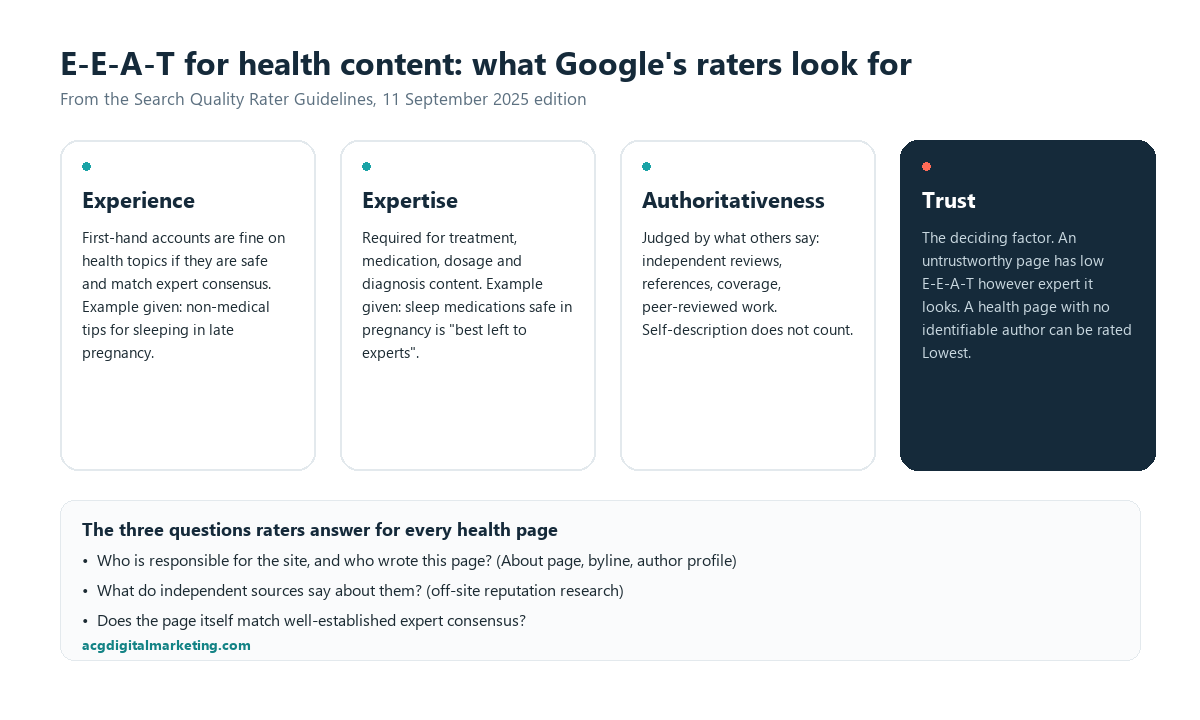
Google’s guidelines put it in one sentence: “Trust is the most important member of the E-E-A-T family because untrustworthy pages have low E-E-A-T no matter how Experienced, Expert, or Authoritative they may seem.”
Raters are told to judge trust from three places. What the site and its authors say about themselves, such as the About page and author profiles. What other people say about them, found through off-site reputation research. And what is visible on the page itself. They are also warned, in section 5.6, not to take claims at face value: assessments should rest on “verifiable credentials” and reputation, “not just website or content creator claims of ‘I’m an expert!'”. A padded author bio is a Low signal, and a fake one is Lowest.
Readers are at least as sceptical as the raters. In Pew Research’s October 2025 survey of 5,111 US adults, 48% rated information from major health websites as highly accurate, against 65% for their own providers, 18% for AI chatbots and 7% for social media. Edelman’s 2025 health trust report found only 38% of Americans trust the media to report health information accurately, down 18 points in a year.
Experience or expertise: which one your post needs
Section 3.4.1 of the guidelines draws the line a wellness blogger has to work with. It says pages that “share first-hand life experience on clear YMYL topics may be considered to have high E-E-A-T as long as the content is trustworthy, safe, and consistent with well-established expert consensus. In contrast, some types of YMYL information and advice must come from experts.”
The examples make it concrete. “Safe and non-medical tips and tricks for sleeping in the last trimester of pregnancy” is valuable experience content. “Sleep medications that are safe during pregnancy” is “best left to Experts”. A forum where cancer patients with lived experience answer each other is given as an example of very high E-E-A-T. A Q&A page giving incorrect advice about chest pain is given as Lowest.
For a blog, that means a personal account of managing anxiety with a routine, a 12-week training log, or a review of a meditation app can stand on its own. Anything about dosages, diagnoses, treatment options, supplements that interact with medication, or what to do about a symptom needs an author or reviewer with credentials that can be checked.
Authority is what others say about you
The guidelines define authority through reputation research, not self-description. Raters look for independent reviews, references, news coverage and, for academic authors, peer-reviewed publications. They are told to discount paid influencer reviews as a conflict of interest.
For a small blog, authority is built off-site: being cited by other health sites, mentioned in a local paper, quoted in a roundup, linked from a practitioner’s own site. That is the same work as link building, done with sources that would survive a rater’s reputation check.
What the 2026 core updates did to health sites
Google ran core updates in December 2025, March 2026 and May 2026, with spam updates in between. The pattern in health was consistent enough that several analysts called it.
After the December 2025 update, Lily Ray’s visibility data showed WebMD down about 43% from its mid-2024 peak and Healthline down about half, with Medical News Today and the Verywell sites following. Her reading was that AI Overviews now answer the informational queries those sites were built on, so fewer people click, and the rankings follow.
The March 2026 core update sharpened it. Ray’s analysis of 2,076 US domains in SISTRIX found the health winners were GoodRx, NIH.gov, Harvard.edu, WHO.int, Cancer.org, Nature.com and Medscape. The losers were Cleveland Clinic, MedlinePlus, WebMD, Mayo Clinic, Johns Hopkins, KidsHealth and the Merck Manuals. SISTRIX’s UK data showed the same shape, with NHS trust domains gaining between 47% and 160% while Merck Manuals fell 30%. SISTRIX summed it up as “authority beats interchangeability”. Google appeared willing to rank the primary source above the publisher explaining it, even when that publisher has strong E-E-A-T by every visible measure.
Glenn Gabe’s write-up of the May 2026 update noted early and heavy movement in health and finance, repeated that “YMYL content is held to a higher standard algorithmically”, and observed that sites hit in January 2026 were not recovering.
For a wellness blog the lesson is blunt. Rewriting what Mayo Clinic already says, however well, is now the most exposed kind of content there is. The institutions that originate the information are outranking the sites that summarise it.
AI Overviews and the health click
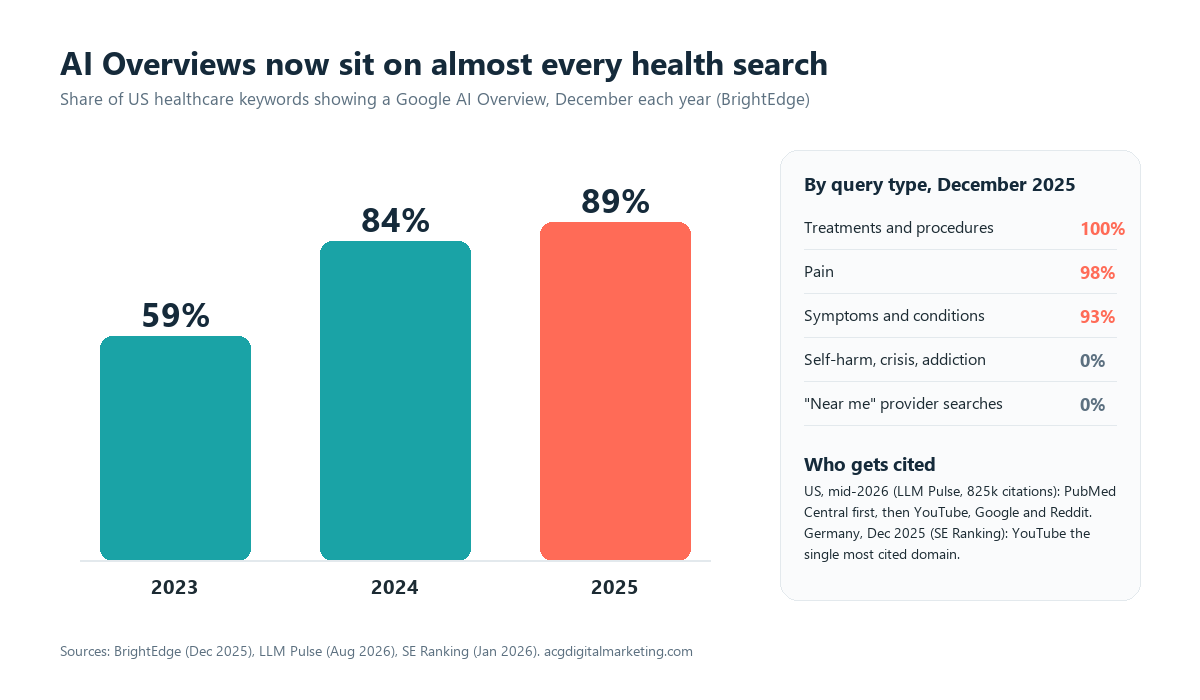
AI Overviews are close to saturation on health searches. BrightEdge measured them on 89% of healthcare keywords in December 2025, up from 59% two years earlier, reaching 100% for treatment and procedure queries and 93% for symptoms. WebFX found 51% of 130,000 US healthcare queries triggered one in July 2025, with longer informational queries at 74%. Google holds them back on self-harm, crisis and addiction queries, and on “near me” provider searches.
Who gets cited is messier than the authority story suggests. In SE Ranking’s January 2026 study of 50,807 German health queries, YouTube was the single most cited domain, and only about a third of citations came from sources built for medical accuracy. LLM Pulse’s analysis of 825,000 US health citations across five AI engines in mid-2026 put PubMed Central first, then YouTube, Google and Reddit, with only 17% of citations going to what it classed as authoritative medical sources. Other studies put the authoritative share far higher. The numbers depend entirely on how each study defines the term, so treat any single figure with suspicion.
What is not in dispute is the click cost. Seer Interactive measured organic click-through falling from 1.76% to 0.61% when an AI Overview is present, and eMarketer reported healthcare organic click-through down 34.5% in the seven months after the feature launched. A wellness blog that depends on “what are the symptoms of” traffic is competing with an answer box that cites NIH.
What a wellness blog should do now
Put a real person on every post. Google says it strongly encourages bylines “where readers might expect it”, and the raters treat a missing author on a health page as a Lowest signal. The byline should be a name, a role and a link to a profile that says what qualifies them, with nothing invented. Google does not verify credentials for ranking, but raters and readers do.
Add a medical reviewer for anything clinical. Healthline’s format is the one to copy: “Medically reviewed by [name, credentials], written by [name] on [date]”, with separate dates for writing, review, fact check and update, and the reviewer’s name linking to a profile and to a page describing the review process. Verywell runs a second, non-clinical review board for wellness content so that a dietitian or a trainer signs off on fitness and nutrition posts. You do not need a board. You need one named, checkable professional per topic.
Write from experience where experience is allowed. The guidelines explicitly reward first-hand accounts on YMYL topics as long as they are safe and consistent with expert consensus. That is the content a small blog can win with, because institutions do not write it.
Cite primary sources and link to them. The raters are told that consistency with “well-established expert consensus is important for medical advice”, and that they should trace claims back to “a highly authoritative source that is known for original content creation”, such as a medical foundation or journal. Link to the study, not to another blog summarising it.
Make the site identifiable. About page, named editorial team, contact details, a privacy policy, HTTPS, and a clear statement of how content is produced. If you use AI tools in drafting, Google’s guidance is to make that self-evident where a reader might wonder, and to fact check every line before publishing. Pages that are mostly AI generated or paraphrased with little added value are rated Lowest “no matter how they are created”.
Mark it up, but do not expect it to rank you. Use Article schema with a Person author, credentials in jobTitle and a sameAs link to a profile, as Google documents. MedicalWebPage, reviewedBy and lastReviewed are valid schema.org properties and harmless to add, but Google has no rich result for them and does not document them. Schema can only mirror what is visibly on the page; marking up a reviewer who is not shown to readers breaks Google’s structured data policy.
Build reputation off the page. Guest posts on relevant health and wellness sites, mentions from practitioners, local press, and being cited in roundups are what a rater finds when they search your name. If you want help placing that content on sites with real readers, our guest posting service handles the outreach and writing, and you choose the domains.
FAQs
What does E-E-A-T mean in SEO?
Experience, Expertise, Authoritativeness and Trustworthiness: the four qualities Google’s Search Quality Rater Guidelines use to judge whether a page can be trusted. Trust is the one that decides the rating.
Is E-E-A-T a ranking factor?
No. Google says E-E-A-T is not itself a ranking factor and that there is no E-E-A-T score. For health and other YMYL topics, Google’s systems give more weight to content that shows strong E-E-A-T, which is why it still matters.
Can a blogger without medical credentials rank health content?
Yes, for experience-based content: personal accounts, routines, product use, safe non-medical tips. The guidelines say this can have high E-E-A-T if it is safe and consistent with expert consensus. Treatment, medication, diagnosis and symptom advice should be written or reviewed by someone with checkable credentials.
Does adding medical review schema help rankings?
No. Google does not document MedicalWebPage or reviewedBy and offers no rich result for them. Use Article schema with a real Person author, and make sure anything in the markup is visible on the page.
Did the 2026 core updates hit health blogs?
The March 2026 core update in particular shifted visibility from consumer health publishers such as WebMD, Mayo Clinic and Cleveland Clinic toward primary sources such as NIH, WHO, Cancer.org and NHS trusts. Small blogs that rewrite institutional information are the most exposed; blogs with original, experience-based content are less so.