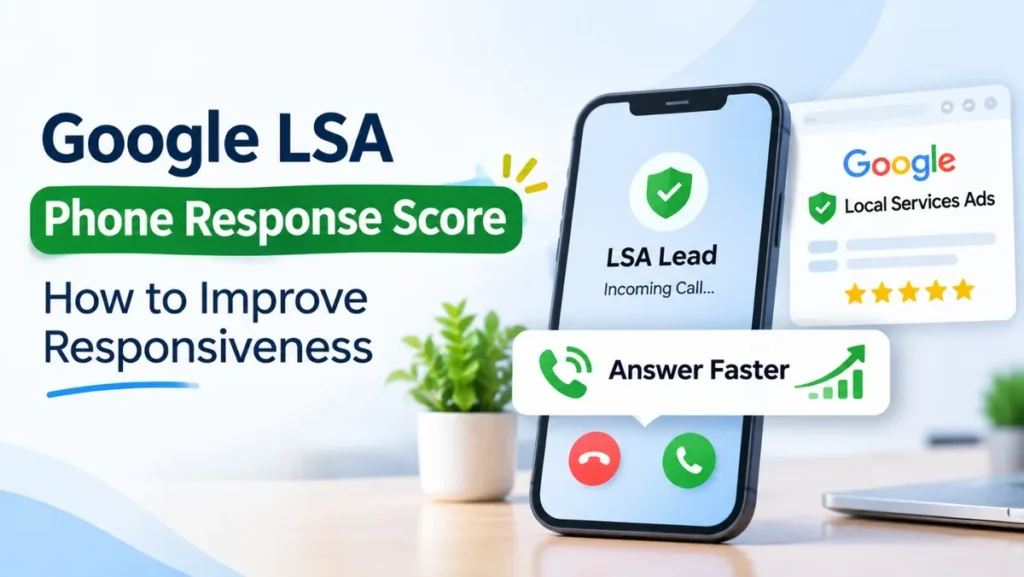
There’s water dripping through someone’s kitchen ceiling. They grab their phone, search “emergency plumber,” tap the first Local Services Ad, and it rings. And rings. No voicemail. They just hang up and tap the next ad. The plumber who missed that call lost a job they’d paid Google to send them, and if it keeps happening, it can count against the plumber’s responsiveness, which is one of the things Google ranks these ads on.
With Local Services Ads (LSA), picking up the phone is part of the advertising, whether anyone in the office thinks of it that way or not. So let’s go through what this “phone response score” people keep mentioning actually is, what Google itself says about responsiveness, and the practical stuff that helps a busy plumbing, HVAC, legal or cleaning business answer more of the leads it’s already paying for.
Is there really a “phone response score”?
Not one you can look up. It’s a phrase marketers use, shorthand for how quickly and reliably you answer LSA calls and messages. Google has no published score by that name, and it keeps the exact ranking formula to itself.
What Google does say, on its own help page about how LSA ads get ranked, is clearer than you might expect. There’s an auction, and it weighs three things: your bid, how likely your ad is to produce a lead, and the quality of your profile. Responsiveness turns up in two of those three. It’s part of the “likelihood of a lead” bit, and “average response time” is listed under profile quality right alongside your star rating, review count, photos and verification checks. There’s also one line that’s hard to misread: missed calls may negatively affect your responsiveness.
So “improving your phone response score” really just means answering more LSA calls, answering them faster, and replying to messages quickly. Nobody outside Google knows exactly how much weight it carries, so be wary of anyone promising a ranking jump. Still, of all the factors, it’s the one most completely in your hands.
What else goes into LSA ranking
It’s worth seeing responsiveness next to everything else Google lists.
| Ranking area | What Google lists |
|---|---|
| Bid | The most you’re willing to pay per lead (you may pay less) |
| Likelihood of a lead | Responsiveness to inquiries, the search context (service, time, location), how relevant your services and business bio are, and whether you accept message or booking leads as well as calls |
| Profile quality | Star rating, number of reviews, average response time, high-quality images, verification checks and other business details |
Two bits of that table are easy to skim past. One is message and booking leads, which I’d point clients at first, since Google counts them in your favor and even says they’re useful “during nights and weekends when you can’t answer the phone,” which is about as close to a hint as Google gets. The other is relevance: your business bio and service list feed into it, so a profile with two vague sentences and a half-filled service list can drag you down even if your team answers every call on the first ring.
Why calls get missed
In a small service business the cause of a missed call is rarely laziness. Usually there just isn’t a free pair of hands at that moment, because the two electricians are halfway up ladders on separate jobs while the one person in the office is already on the other line, or the whole law firm is in the Tuesday partners’ meeting. Leads seem to have a talent for arriving at exactly those times.
The next most common culprit is that the ads and the staffing don’t line up. If your LSA hours run until 9pm but nobody’s been at the desk since 5, then every lead in those four hours is left to luck, and some of them will go to whoever answers next. Then there’s the technical stuff: forwarding that rings a phone somebody left in a drawer, a forwarding chain that quietly drops the call, or a setup where nobody is actually in charge of checking new leads, so everybody assumes someone else did.
I’d find out which of these you’re dealing with before changing anything, and it doesn’t take long. Pull a few weeks of LSA lead history, write down the time of every missed call, and look for clumps, because they’re usually obvious once they’re on paper, whether that’s lunchtime, the first hour of the morning, Saturdays, or that dead stretch between the office closing and the ads switching off.
Answering faster during business hours
Most of the fix here is agreeing on a simple rule so nobody has to think about it in the moment: who answers first, who picks up if that person’s busy, and how many rings it gets before the call moves on to someone else. Three or four rings is a reasonable place to start, though that’s a target you set for yourselves, since Google hasn’t published a threshold or a magic number of seconds that earns better placement.
Answering fast is only half of it, though. The person who picks up should be able to tell the caller what you do, roughly when someone could come out and how your pricing works, and they need to grab the details you’ll need to book the job. Honestly, “hi, can I take a message?” is still better than letting it ring out, but the ad only really pays for itself when the call ends with a booked appointment.
Make your hours match reality
My advice is to set your LSA hours to the times when somebody can genuinely respond, even if that means fewer hours than you’d like. It’s tempting to stretch them for the extra exposure, but a lead that arrives when nobody’s around turns into a missed call or a slow reply, and those are exactly what can pull your responsiveness down.
If you want to keep the longer hours, you’ll need cover for them. It also helps to know how Google measures message replies: it takes a weighted average of your response time over the last 90 days, counting only your stated business hours (or 7am to 9pm if you never set any), and giving recent leads more weight. And when you’re away on vacation, short-staffed or simply booked solid for the next couple of weeks, you can pause the ads instead of letting leads pile up with nobody to answer them.
Emergency trades are their own thing. If your ad promises 24-hour service, then somebody needs to be picking up at 3am, whether that’s you, an on-call rotation or a service.
Call forwarding and reception cover
Plenty of missed calls happen simply because the phone only rings in one place. Forwarding fixes that by passing an unanswered call to a second person, then a third, or on to a reception service, and the only real trick is keeping the rings at each step short enough that the caller doesn’t give up halfway down the chain. I’d test the whole thing from your own cell phone before trusting it with real leads.
Once the calls get busy, or your team spends most of the day out on jobs, a receptionist starts to earn their keep, whether you hire one or use an outside service. A good one answers with your business name, works out what the problem is and where, and books the visit by your rules. I would check on them now and then, though, by calling your own number as if you were a customer, because a service that answers quickly but can’t book anything or gets the address wrong isn’t much of an upgrade over voicemail.
Automated answering for the gaps
For the hours you just can’t staff, automated call tools and AI receptionists can fill in. What they do depends on the product, but the useful ones will take the caller’s name, number, address and problem, flag anything urgent, and send your team a text or email so someone calls back.
Say every plumber in the company is out on a job when a burst-pipe call comes in. The system can log the ZIP code and what’s going on and ping whoever’s on call, which beats a ringing phone in an empty office by a mile. I’d still keep a clear route to an actual human for anything urgent or complicated, and run a test call every so often, because the tool only catches the call and your bookings still depend on what your team does with it afterward.
Switch on messages and bookings
This might be the easiest win in the whole post. Google counts it in your favor when you accept message or booking leads, and it gives the customer who can’t get through, or who’d simply rather not phone, another way to reach you.
The thing to watch is that your average response time is measured on how fast you reply to messages, so they can’t sit unread until Monday. I’d put the Local Services Ads app on the phones of whoever handles leads, or route the notifications to them some other way, and keep the first reply short; something like “got your request, we’ll call you within the hour” is plenty to stop the clock on your response time.
A plan for the calls you do miss
You’ll still miss some, because everyone does, and what makes the difference is how quickly you call back. I’d make one named person responsible for checking missed LSA leads, give them a target to aim for (within 15 minutes during working hours is a sensible internal goal), and make sure they have the lead details in front of them so the customer doesn’t have to explain the leak all over again.
Urgency should decide the order. Somebody with a burst pipe, or no heat in the middle of January, needs a call back in minutes, while a request for a quote on next spring’s patio can comfortably wait an hour. Google hasn’t said whether a fast callback cancels out the missed call in its eyes, but it rescues the job often enough, and the job is the thing you were paying for.
Keep your own scorecard
Since Google doesn’t show you the full responsiveness calculation, it’s worth keeping your own records. Once a week, I’d jot down:
- total LSA calls and messages
- how many calls were answered and how many missed
- how long callbacks took
- how many leads became booked jobs
After a few weeks those numbers will tell you whether the changes are working and where the remaining gaps are. Many phone systems can also break missed calls down by hour of the day, which is the quickest way I know to spot a staffing hole. And when a lead is obviously junk, like spam or a wrong number, flag it with lead feedback in your LSA account; Google reviews leads now and credits a lot of the invalid ones automatically.
The rest of the profile still counts
Responsiveness is only one slice of the ranking, so the rest of the profile deserves some attention too: the right service categories and service areas, a business bio that tells people something real, photos from actual jobs, verification checks that are current, and a steady trickle of genuine reviews from real customers. Replying politely to reviews, grumpy ones included, is part of that.
Your Google Business Profile and your LSA profile also tend to hold each other up, since both show up when someone searches locally. If yours could use some work, that’s exactly what our Google Business Profile management and local SEO services cover.
The short version
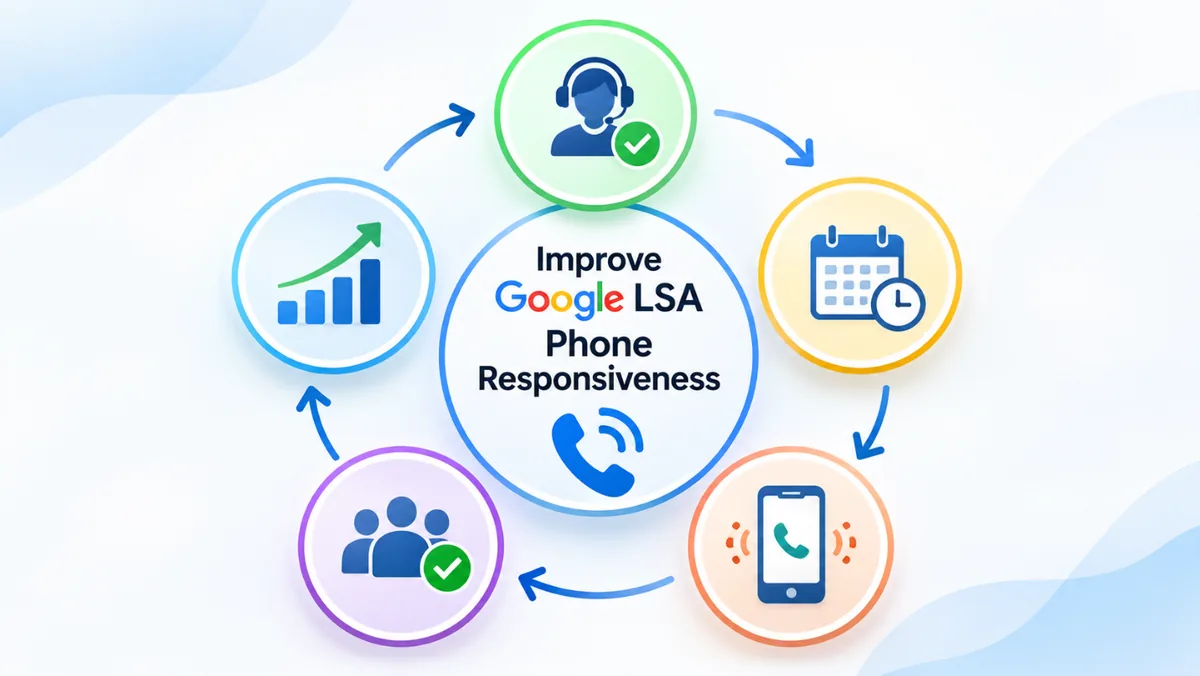
There isn’t an official “phone response score,” but Google is clear that responsiveness and average response time feed into how Local Services Ads are ranked, and that missed calls can hurt. If you work out when and why calls are slipping through, match your hours to the people you’ve actually got, add forwarding or reception cover, switch on messages and bookings, and call back quickly when one gets away, you’ll answer far more of the leads you’re already paying for. And if you’d like a second pair of eyes on your local search setup, get in touch.
Frequently asked questions
What is the Google LSA phone response score?
It’s the unofficial name people give to how quickly and reliably you answer Local Services Ads calls and messages. Google doesn’t use the phrase, but its ranking help page lists responsiveness and average response time among the factors, and it warns that missed calls may hurt your responsiveness.
Do missed calls affect Local Services Ads ranking?
Google says they may hurt your responsiveness, which is one of the things it ranks on. What it hasn’t published is a number of missed calls that triggers a drop, or how much responsiveness counts compared with everything else, so anyone quoting you exact figures is guessing.
How fast should I answer LSA calls?
As fast as your team can manage on an ordinary busy day, not just on quiet ones. I’d start with a target of three or four rings and track how often you actually hit it, since Google itself hasn’t put a number on it.
Can an answering service help with LSA responsiveness?
It can catch the calls your team can’t, which is a big help. Just make sure the service can answer the basic questions and book jobs properly, and call them yourself a few times to see how they handle it.
How long until better responsiveness shows up in results?
Google doesn’t give a timeline. Message response time is worked out over 90 days with recent leads weighted more heavily, so your faster replies start to count fairly soon while the older slow ones fade out gradually, and the sensible thing is to keep going and compare leads and bookings month by month.
Is responsiveness more important than reviews or budget?
Google hasn’t ranked them against each other. Your bid, your responsiveness, how relevant your profile is and your reviews all play a part, so I’d work on all four rather than bet everything on one of them.