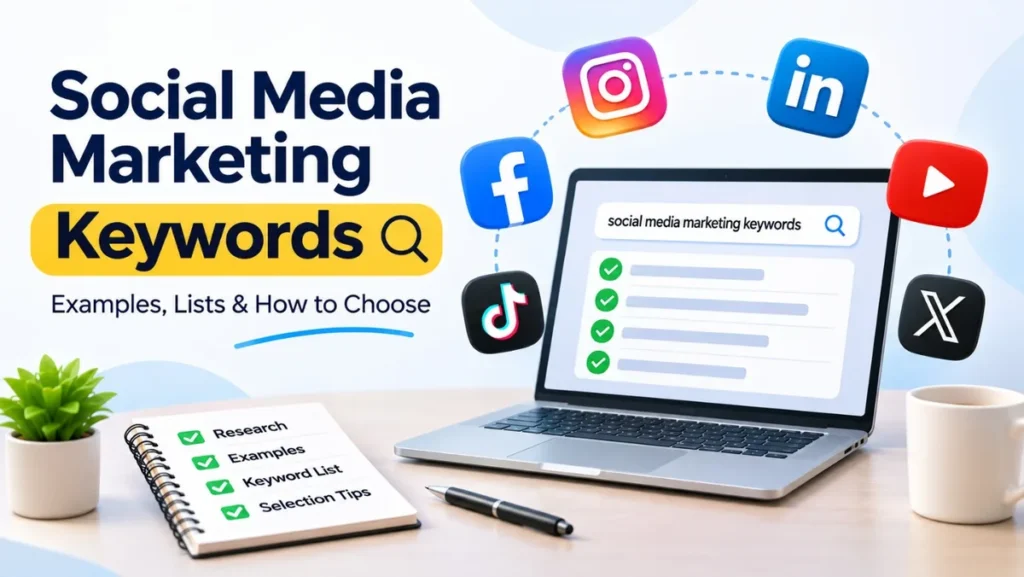
Watch how some people look for a brunch spot these days and you’ll notice they don’t open Google at all. They type “best brunch in Pune” straight into Instagram, or “how to fix a leaky faucet” into TikTok, and pick from whatever comes up, while their B2B counterparts are doing the same thing on LinkedIn with “B2B content strategy.” So if your captions never use the words those people are typing, you’re basically hoping the feed takes pity on you.
Hence keywords. On social they’re nothing grander than the words that tell the app, and the half-asleep person thumbing through it at 11 p.m., what on earth your post is about. Below: the kinds worth caring about, a starter list, the spots where I go digging for an audience’s own phrasing, and how I whittle the pile down to a few that deserve a proper content plan.
What social media marketing keywords are
Shortest definition I’ve got? Your topic, in your audience’s words. So a home fitness coach ends up building around stuff like “home workout for beginners” and “no-equipment workout,” and a tax advisor’s world is “quarterly estimated taxes” and “small business tax tips,” which, granted, are less fun to film. Wherever they come from, they go in the caption, the video title, the description, the text on screen and your bio.
One thing that trips people up is assuming these work like website keywords. Google judges a web page largely on the words on it and the links pointing at it. Instagram and friends are far more interested in what people do with a post, so the watch time, saves, shares and comments it racks up end up deciding who gets shown it next. My rough mental model is that the keyword gets you into the right room and the engagement decides whether anyone stays to listen.
There’s another reason to care that’s fairly new. Since July 2025, public posts from Instagram professional accounts (business and creator accounts run by adults) can show up in Google’s search results, which means a caption with clear keywords in it can now be found through Instagram’s own search and through Google as well.
The main types of social media keywords
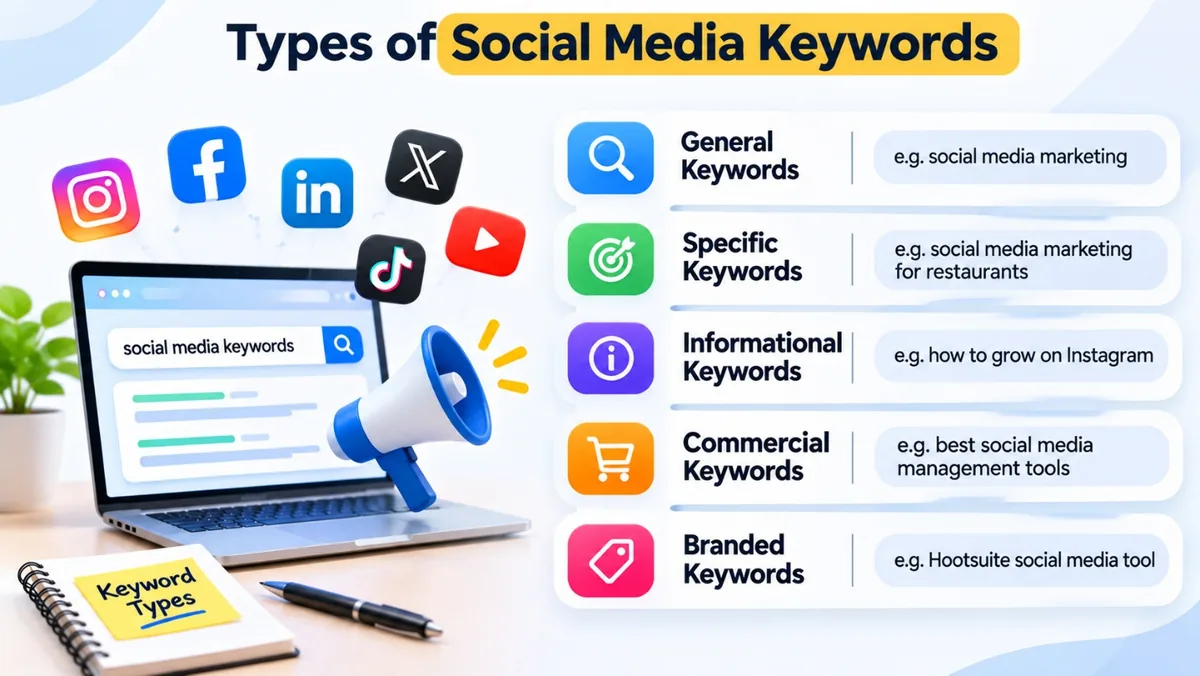
I find it easiest to sort keywords by what the person searching is after.
| Type | What it means | Example |
|---|---|---|
| General | Broad topic words with lots of competition | social media marketing |
| Specific (long-tail) | Narrower phrases for a particular need | social media marketing for restaurants |
| Informational | The person wants to learn something | how to grow on Instagram |
| Commercial | The person is comparing tools or providers | best social media management tools |
| Branded | Names a particular business or product | Hootsuite scheduling |
For most businesses I’d lean toward the specific and informational rows. General keywords are handy in a profile bio, but an enormous number of accounts are chasing them, and a narrower phrase like “Instagram ideas for dental clinics” reaches fewer people who are far more likely to be the ones you want.
A starter list of social media keywords
I’ve grouped these by theme. Fair warning, it’s a list of phrases you’ll see a lot in social media marketing, not a ranking of search volumes, so use it as a jumping-off point and keep only the ones that fit the people you actually want to reach.
| Theme | Example keywords |
|---|---|
| General | social media marketing, social media strategy, social media management |
| Paid social | social media advertising, paid social campaigns, Instagram ads, Facebook ads |
| Content | social media content ideas, content calendar, Instagram post ideas, reel ideas |
| Small business | social media marketing for small business, social media tips for local business |
| Platform specific | Instagram marketing, LinkedIn marketing strategy, YouTube Shorts tips, TikTok for business |
| Influencers | influencer marketing strategy, creator collaborations, UGC content |
| Engagement | social media engagement, grow Instagram followers, how to get more comments |
| Analytics | social media analytics, Instagram insights explained, engagement rate |
| Services | social media manager, social media management services, social media agency |
If you’re an agency selling social media management, the services and small business rows are probably home. A creator teaching marketing, on the other hand, would hang out mostly around content, engagement and the platform rows.
Where to find the words your audience uses
I’d start with people before opening any tool. Go back through your DMs and comments, or think about what people ask on the phone, and write down their exact words for the problem, which will almost never match yours. Dentists talk about “teeth whitening.” Patients type “how to get whiter teeth.” Guess which one makes the better keyword.
After that, the platforms will show you a lot for free. Type half a topic into the search bar on Instagram or TikTok (YouTube, Pinterest and LinkedIn do it too) and watch what it suggests, because those suggestions come from what people really search. I usually click into the top few results and jot down the words they use in captions and titles, and I’ll snoop through competitors’ comment sections as well, mainly for the questions their followers keep asking.
A few platforms have proper research tools too. TikTok’s Creative Center has a Keyword Insights section built on TikTok ad data, Pinterest Trends shows what’s rising on Pinterest, and Google Trends can compare interest in phrases over time, YouTube searches included. The usual SEO tools (Keyword Planner, Ahrefs, Semrush) will turn up more ideas with rough search volumes, but keep in mind those numbers come from Google search rather than from inside Instagram or TikTok, so I’d use them to gauge what people care about and not as a measure of social search.
How to choose the right keywords
Once the list is long, I’d run each phrase past four questions to cut it down.
The first is whether it’s relevant to something you actually post about or sell. A popular phrase that drags in the wrong crowd does more harm than good, because those people don’t engage, and weak engagement can tell the platform your content isn’t worth showing more widely.
Second, what does the person searching want? “Social media marketing tips” is a learner. “Social media management services near me” could be a client with a budget. I’d want both, honestly, but they get fed different things, the first a how-to carousel and the second a case study or a service post.
Third, and be honest here, could you actually win it? A brand-new account going after a broad phrase is in a fistfight with the biggest creators in its niche, and it usually loses, so I’d rather pick something narrower where it has a real shot.
Last one: what’s this particular post meant to do for you? Awareness, engagement, leads and sales all want slightly different phrases. If you run paid social, the ad tools will show cost and competition for some keywords, which is useful, but I wouldn’t read those numbers as a forecast for how a phrase will do organically.
Take a bakery in Pune that sells custom cakes. It might start with “cakes,” which is hopelessly broad, then narrow it down to “custom birthday cakes Pune,” “eggless cakes Pune” and “theme cakes for kids.” Each of those is specific, matches what local customers actually search for, and leads pretty directly to an order.
Adjust keywords for each platform
Pasting your LinkedIn caption straight onto Instagram saves five minutes and usually falls flat, because each app has its own way of talking and people search on each one a little differently. The same idea tends to need fresh wording for wherever it’s headed.
| Platform | Where keywords go | What tends to fit |
|---|---|---|
| Bio, name field, captions, alt text, on-screen text in Reels | Plain descriptive phrases, local terms | |
| TikTok | Captions, on-screen text, spoken words | How-to and problem-based phrases |
| YouTube | Title, description, chapters, spoken words | Full questions and “how to” searches |
| Headline, About section, post text, articles | Industry and job-role terms | |
| Pin titles, descriptions, board names | Ideas, inspiration, seasonal phrases |
A phrase like “enterprise content governance framework” is perfectly at home in a LinkedIn article. Try saying it out loud in a 20-second TikTok, though, and see how long anyone sticks around.
Organize keywords into content themes
Trying to plan a month of posts straight off a spreadsheet of 200 keywords is miserable, so I bunch them into somewhere between four and six themes first. You’ll hear these called content pillars. For a digital marketing agency they might be strategy, content creation, paid ads, analytics and engagement, and then each pillar gets a spread of formats over the month, maybe a how-to Reel one week and a carousel or a quick case study the next, with the occasional Q&A thrown in.
The nice side effect is that the calendar more or less balances itself, because you’re rotating through pillars instead of accidentally posting about hashtags five times in a row. People landing on your profile also get a much clearer idea of what you’re about, and from what I can tell the algorithm does too.
Use keywords naturally
If a caption says “social media content calendar” five times in four lines, readers notice, and they scroll. The keyword is supposed to make the post easier to understand, not harder. So I put the main phrase in the spots where it would end up anyway if you were just writing normally: the opening line of the caption, the video title, the first sentence you say on camera in a Reel, and your profile’s name field and bio.
Say the post is about planning a month of content. Opening with “Here’s how we plan a social media content calendar for the whole month” is a perfectly normal thing to say, and it happens to contain exactly what somebody would type into search.
Hashtags? Still useful for a bit of sorting, but they’re a different animal from keywords and frankly a smaller one than they were a few years back. Instagram cut down how many a post can carry, and the big apps lean on your caption and on-screen text now, so they don’t need tags to know what your post is about. I’d take a few precise tags and a caption that sounds like a person wrote it over a long wall of vaguely related ones any day.
Measure what’s working
Back to our Pune bakery, a month into using “eggless cakes Pune” in its captions. Is the phrase pulling its weight? You’d find out by opening each post’s numbers (reach, views, saves, shares, profile visits, follows, and the website clicks or inquiries that actually pay the rent) and keeping a running note of which keyword or theme each post was built around. There’s a handy extra in Instagram’s insights too, a breakdown of where a post’s views came from, and if a decent slice came from search that’s about as clear a sign as you’ll get that people typed the phrase and found the bakery.
I’d give it a quick glance every month and a proper sit-down once a quarter. Whatever pulls in the right kind of people, do more of. If a keyword seems to flop, though, I’d look at everything else before blaming it, because a dull first three seconds, the wrong format or a post that went out at 2 p.m. on a Tuesday can sink a perfectly good phrase.
Mistakes to avoid
The one I’d warn a new client about first is falling for big numbers. A keyword with enormous volume looks thrilling in a spreadsheet, but in practice you’re up against the largest accounts in your space and pulling in people who were never going to buy a cake, or a consultation, or whatever it is you sell.
Copy-pasting is a close second. One keyword set, slapped on every app. But the tidy corporate phrasing that does fine on LinkedIn sounds like a press release on TikTok, and the people there search differently anyway, so rewrite it.
Stuffing creeps in without anyone meaning it to: the same phrase three times in a caption, a pile of hashtags with nothing to do with the post, or a competitor’s whole keyword list lifted without anyone checking whether it fits. And the sneakiest mistake of all is doing this research once and then never opening the list again, even though slang, trends and the apps themselves change fast enough that a list from last year is probably due for a rethink.
Bringing it together
Strip all this back and it’s mostly listening. Your DMs, your comments and the search bar suggestions are already full of the right words, so the job is largely gathering them up, keeping the ones that suit both your audience and what you’re trying to get out of social, grouping them into a few themes, and letting each month’s results tell you which ones have earned another round.
It’s also worth knowing that social search and Google search are drifting closer together, so the same thinking pays off on your website. If you’d like a hand with that side, our content writing and SEO blog service and on-page SEO services both begin with exactly this sort of keyword research, or you can simply get in touch and we’ll talk it through.
Frequently asked questions
What are social media marketing keywords?
Whatever someone would type if they were hunting for your post. A yoga teacher’s might be “morning yoga for back pain,” a bakery’s “eggless birthday cake.” They go wherever the app can read them, which means captions, titles, descriptions, on-screen text and your bio.
How do I find the best keywords for social media?
Customers first, every time; their DMs usually beat my brainstorming. Then the search bars: half a topic typed in, see what the app suggests, peek at the posts that come up. If you’re still short of ideas, try TikTok’s Creative Center, Pinterest Trends, Google Trends or a regular keyword tool.
What’s the difference between keywords and hashtags?
Keywords live in your caption, title, bio and whatever you say on camera; hashtags are the little #labels that bundle posts together. Since the apps lean more on captions and on-screen text these days, I’d let keywords carry most of the weight and treat a few good hashtags as a finishing touch.
Are long-tail keywords useful on social media?
For most small accounts they’re the best bet going. Someone searching “social media ideas for small restaurants” has told you exactly what they need, there’s far less competition for it, and they’re a lot more likely to engage or buy than whoever typed plain “social media marketing.”
How many keywords should I use in a post?
There’s no rule. A two-line caption might hold one main phrase, and a YouTube description or a LinkedIn article could fit several related ones without strain. My test is to read it out loud, and if it sounds like it was written for a search engine rather than a person, I take some out.
How often should I update my social media keyword list?
Monthly for a quick performance check and quarterly for a deeper look is what I’d suggest for most businesses, with more frequent check-ins if your industry changes quickly.